Cute Scientist Kid Graphics & Illustrations
As a graphic designer who’s delivered brand identities for STEM-themed kids’ apparel lines, educational subscription boxes, and local science festival campaigns, I opened Cute Scientist Kid with Gadgets and Spac expecting charm—but what stood out immediately was its intentional balance: playful curiosity without visual noise, scientific whimsy without clutter. This isn’t just clipart—it’s a considered graphic design asset built for real-world application.
A First Impression That Sets the Right Tone
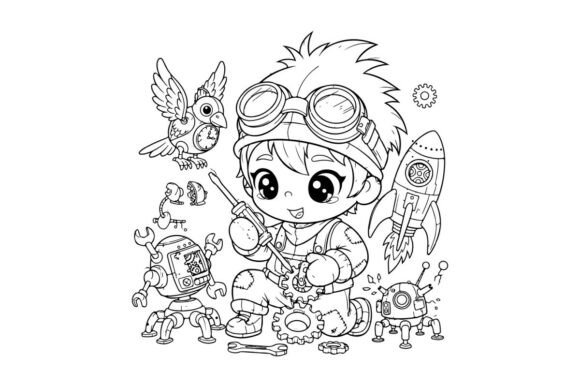
The illustration greets you with confident, clean line work—no shaky vectors or inconsistent stroke weights. The scientist kid wears oversized goggles, holds a stylized rocket, and stands beside a friendly robot and floating atom. There’s gentle asymmetry in the composition, soft curves in the hair and gear details, and just enough interior linework to suggest texture without overwhelming. It reads as modern design with handmade warmth—ideal for brands that want to feel approachable, intelligent, and inclusive.
Where It Shines in Client Projects
I recently used Cute Scientist Kid with Gadgets and Spac in a packaging design refresh for a small-batch science kit company targeting ages 5–9. We placed it as a central hero graphic on box lids and product mockups—and instantly elevated perceived value. Its bold outlines hold up beautifully on matte kraft paper and glossy sticker sheets alike. It also translated seamlessly into:
- Printable designs for classroom handouts and homeschool activity packs—especially effective when paired with simple sans serif fonts like Poppins or Nunito
- Social media graphics for Instagram carousels and Pinterest pins—its expressive face and clear focal point drive engagement without needing text overlays
- Cricut project files for custom lab-coat patches and event badges—clean edges meant no weeding frustration
- Sticker design and sublimation design assets for mugs, tote bags, and enamel pins—works equally well at 2” and 12” scales
- Canva template elements for educators launching digital courses—added instant thematic cohesion to slide decks and workbook covers
Strategic Placement Matters Most
This illustration thrives in large layout areas: hero sections, poster backgrounds, wall art prints, and full-bleed packaging panels. Its emotional appeal is strongest when given breathing room—think a single figure centered on a greeting card or framed as printable wall art for a child’s learning space. It also strengthens themed collections, especially when grouped with complementary illustrations (e.g., astronaut, inventor, biologist variants) to build a cohesive design bundle.
It performs reliably in marketing visuals for science camps, library summer programs, or indie toy shops—adding warmth to otherwise clinical topics. As part of a brand identity, it works best as a secondary element: not the logo itself, but the friendly face behind the brand voice on email headers, blog banners, and product labels.
Where Caution Is Required
Don’t force Cute Scientist Kid with Gadgets and Spac into tight spaces. At under 1.5 inches wide, facial expressions and gadget details blur—making it unsuitable for tiny app icons or fine-print packaging footers. Avoid pairing it with ultra-minimalist branding: if your client’s aesthetic leans toward monochrome typography and negative space, this illustration may disrupt visual hierarchy rather than support it.
It’s also less effective against complex or low-contrast backgrounds—busy patterns, gradient overlays, or dark gray tones can mute its clarity. And while it’s perfect for handmade business storytelling, it doesn’t convey authority for corporate B2B tech clients or medical device startups. Reserve it for projects where creative design serves empathy, education, and joyful discovery.
Designer Notes You Can’t Skip
Before using Cute Scientist Kid with Gadgets and Spac in any commercial design context, here’s what I test every time:
- Check contrast on both light and dark backgrounds—especially important for social media graphics and web design
- Preview in black and white—this reveals whether line weight and spacing hold up without color cues
- Scale it down to 0.75x and up to 3x—confirms SVG scalability or PNG resolution integrity
- Place it on real product mockups—I use it on mug, sticker sheet, and t-shirt templates to assess proportion and impact
- Test print quality—run a sample on your target paper stock; some printers soften fine linework
- Inspect PNG transparency—if included, verify crisp edges and no haloing around the figure
- Compare font pairings—it harmonizes with rounded sans serifs (Quicksand), friendly scripts (Caveat), and sturdy display fonts (Bangers)—but clashes with thin serifs or rigid geometric type
- Confirm commercial license—this is non-negotiable for Etsy product listings, print-on-demand storefronts, or client deliverables
Why It Builds Trust—and Why Clients Notice
What makes Cute Scientist Kid with Gadgets and Spac more than decoration? It signals intentionality. Parents scanning an online product launch subconsciously register care in the line quality and thoughtful detail—traits they then associate with the brand itself. For content creators and bloggers, it adds authenticity to posts about early STEM exposure. For crafters and digital sellers, it delivers immediate thematic resonance—no custom illustration needed.
In editorial design, it helps break up dense text blocks while reinforcing subject matter. In packaging design, it invites tactile engagement—kids reach for the box because the character feels familiar and kind. That emotional hook supports conversion, retention, and word-of-mouth sharing.
Final Verdict for Real Work
Cute Scientist Kid with Gadgets and Spac is a versatile, mood-enhancing illustration—not a one-trick PNG. It earns its place in my active design assets folder because it solves multiple problems at once: humanizing technical themes, adding visual rhythm to flat layouts, and delivering consistent tone across touchpoints. Whether you’re building a small business branding system, designing a digital product for teachers, or curating a creative marketplace collection, this piece brings calm creativity—not chaos—to the process.