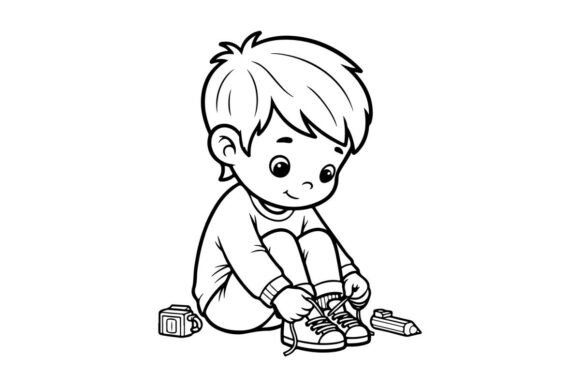
Cute Boy Tying Shoelaces Vector Illustra
When I first opened the Cute Boy Tying Shoelaces Vector Illustra file, I immediately recognized it as a classic coloring book page, but my mind went straight to stitching. The clean, bold line art and the perfectly balanced composition make this far more than a simple illustration. For embroiders, it reads like a ready-to-digitize pattern that can carry a lot of charm on a finished product. The mood is gentle, a little nostalgic, and undeniably sweet—a child learning an everyday skill, frozen in a moment that feels universal. That kind of visual storytelling is exactly what sells well on handmade items, and it’s why I wanted to evaluate this design with real project use in mind.
As a designer who reviews embroidery assets regularly, I’ve learned to look past the preview and ask how a motif will actually behave under the needle. The Cute Boy Tying Shoelaces Vector Illustra has a lot going for it: the lines are thick enough to function as satin stitch outlines without becoming blobby, the details are spaced out so they won’t merge into a mess on medium-weight fabrics, and the overall shape fits comfortably into standard hoop sizes. But I also see areas where a little extra care will make the difference between a professional finish and a project that frustrates a maker. Let’s walk through it piece by piece, from a real crafter’s perspective.
Clean Lines and Balanced Details
The artwork’s strength lies in its simplicity. The boy’s figure, the bent knee, the shoe, and the laces are all drawn with a confident, unbroken line quality that translates beautifully to running stitch or light satin outlines. There’s no excessive interior shading or tiny speckles that would force a digitizer to create dense, problematic fill areas. Because the original piece is a coloring book design, it already respects negative space—something machine embroidery desperately needs for a clean, readable result. The Cute Boy Tying Shoelaces Vector Illustra won’t overpower a garment; it will sit like a thoughtful, hand-drawn accent.
That said, the “perfectly balanced details” mentioned in the product description are real. The laces have a few loops, the shoe has just enough shape, and the boy’s expression is hinted at rather than overloaded with facial features. This restraint is a gift for small embroidery projects. When you shrink this down to fit on a baby onesie or a cap front, you won’t lose the subject—it’ll still read clearly as a child tying his shoes. That’s a huge plus for sellers who need designs that work across multiple product sizes.
Real-Life Embroidery Project: A Custom Baby Gift
Let me ground this in a real scenario. I’m currently planning a personalized baby shower gift—a soft, organic cotton muslin swaddle blanket with a delicate embroidered corner motif. I could easily use a simplified version of the Cute Boy Tying Shoelaces Vector Illustra as the focal point, paired with the baby’s name and birth date in a tiny, elegant font. The image would evoke that tender milestone when a child starts learning to dress themselves, and parents would absolutely melt over it. Alternatively, I’d stitch it on a tote bag for a mother’s day present, using a single color thread on natural canvas. The design’s gentle theme makes it suitable for nursery decor, keepsake pillows, or even a small framed hoop art piece.
In these gift contexts, the design’s mood matters as much as its stitch quality. The Cute Boy Tying Shoelaces Vector Illustra doesn’t feel trendy or cartoonish; it has a timeless, storybook character that appeals to a wide range of customers. When I picture it on a finished product, I see handmade items that look elegant rather than cheap, which is exactly what boutique buyers and Etsy shoppers expect. The emotional hook is strong—parents, grandparents, and anyone who treasures childhood memories will connect with it instantly.
Fabric and Stabilizer Choices
Before you digitize any illustration, you have to think about the fabric it’ll land on. For the Cute Boy Tying Shoelaces Vector Illustra, I’d recommend starting with medium-weight, stable fabrics like cotton twill, linen, or quilting cotton. These take the stitch well and won’t pucker under moderate density. If you’re aiming for a sweatshirt or a knit garment, use a cutaway stabilizer and consider a light water-soluble topping to prevent the stitches from sinking into the fabric nap. I’ve seen too many pretty designs ruined on fluffy fleece because the outlines disappeared. With this design’s open linework, you can get away with minimal underlay, but always test on a scrap that matches your final fabric’s texture and stretch.
For small hoop sizes, say 4x4 inches, you’ll need to scale the design carefully. The boy’s hands and the shoelace loops are the most delicate parts. If you go too small, those loops might close up or become a dense knot. I’d keep the design at least 3.5 inches tall to maintain clarity. Thinner fabrics like lightweight jersey or silk will require extra stabilizer and a slower stitch speed to avoid distortion. Curved surfaces like caps demand precise placement and often a design that sits low and wide—this one’s vertical orientation might need tweaking for structured hats, but it’s perfect for tote bags, flat shirt fronts, and pillow covers.
Thread Color Selection and Contrast
Because the Cute Boy Tying Shoelaces Vector Illustra is essentially a line drawing, thread color becomes the entire voice of the project. A single shade of navy, charcoal, or soft brown on a cream background creates a sophisticated, minimalist look that sells well in modern home decor and baby boutiques. If you want to add a playful touch, stitch the shoe in a contrasting color and leave the rest in one tone. I always test the design in black and white first—print it out, place it on a swatch, and check if the silhouette holds up. If the design gets lost on dark fabric, you might need to invert the colors or use a lighter thread than the background. Dark fabric can be tricky because the bold lines of the illustration may not pop without a brightly colored thread, so plan your palette accordingly.
Where This Design Shines and Where to Be Cautious
I’d confidently place the Cute Boy Tying Shoelaces Vector Illustra on kitchen towels, aprons, tote bags, simple sweatshirts, and flat pillow covers. It’s a natural fit for personalized gifts, baby shower merchandise, and boutique children’s clothing. The open layout also makes it easy to combine with a monogram or a short phrase, which increases its value for custom orders. Embroidered patches are another strong option—digitize the design with a merrowed edge finish, and you’ll have a sweet patch that can be sold individually or applied to caps and jackets.
Use caution on very textured fabrics like terry cloth or thick fleece, where the eyelash texture can swallow the shoelace details. Also, avoid placing this design over seams, zippers, or highly curved areas without adjusting the digitizing for push and pull compensation. The laces might look crisp on screen, but if the fabric stretches during hooping, the loops can distort and lose their charm. A test stitch on a scrap of the exact fabric is non-negotiable. Additionally, if you’re creating a product that will be washed frequently, choose polyester threads that can withstand hot water and avoid overly dense satin columns that might break.
Commercial Use and Licensing for Craft Sellers
One of the most important steps before you list a finished product is to confirm what the license allows. The Cute Boy Tying Shoelaces Vector Illustra is listed under the Illustrations category and Graphics type, which typically means you’re purchasing a digital file that you can use for personal projects or, with the right license, for commercial embroidery. However, I always advise crafters to read the specific terms. Some licenses permit selling finished physical items but prohibit reselling the digital file or using it in print-on-demand mockups. If you want to display the design in a digital product preview on Etsy, make sure the license covers that usage. For small business owners, investing in a commercial license protects your shop and gives you peace of mind when you’re producing batch orders for craft fairs or wholesale clients.
Final Thoughts from a Designer’s Perspective
Overall, the Cute Boy Tying Shoelaces Vector Illustra earns a strong recommendation for embroiderers who want a design that’s easy to digitize, versatile across products, and emotionally resonant. The bold, coloring-book style line art is practically made for stitching, and the balanced composition saves you from headaches during the digitizing phase. It’s not a hyper-detailed, multi-layer masterpiece, and that’s exactly why it works—it prioritizes clarity and charm over complexity.
Before you commit to a large production run, take these practical steps:
- Test stitch on a fabric scrap that matches your final product’s weight and weave.
- Experiment with thread color contrasts on both light and dark backgrounds.
- Check your hoop size and confirm the design fits comfortably without crowding the edges.
- Inspect small details like the shoelace loops and fingers after stitching to ensure they remain distinct.
- Review the licensing terms to confirm you can sell finished items, use the design in mockups, or offer it as part of a commercial embroidery service.
- Use proper stabilizer and consider a topper for plush or knit fabrics.
If you treat this illustration as a creative starting point rather than a one-click solution, you’ll produce handmade products that carry a genuine, heartfelt appeal. The Cute Boy Tying Shoelaces Vector Illustra belongs in a maker’s digital library right next to other timeless, story-driven motifs that turn ordinary fabric into something people treasure.